One-Stop Comprehensive Hotel Supplies: Zone-by-Zone Planning for New Hotel Projects
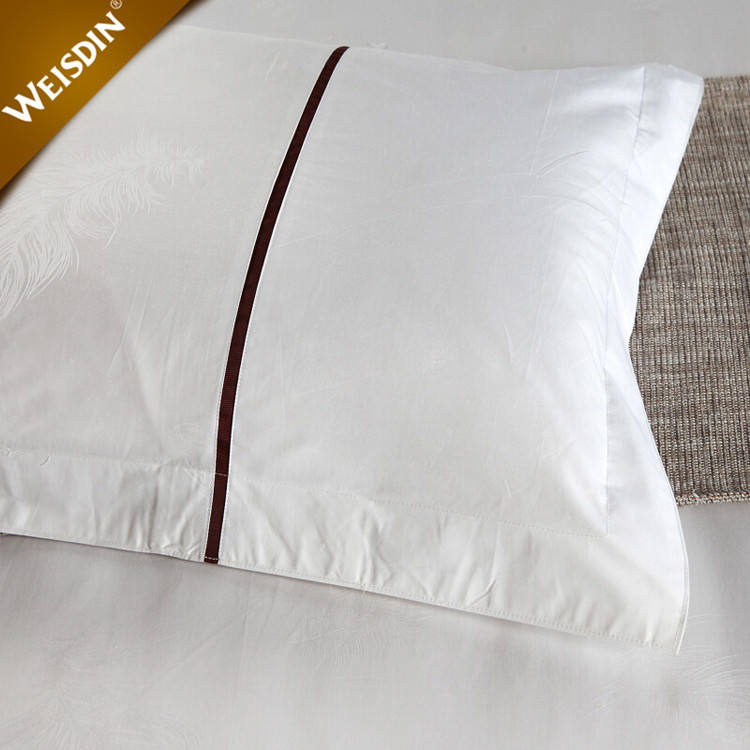
Cover: Jacquard Bedding Set from the WEISDIN hotel linen range, one of the four product zones in a one-stop hotel project supply plan.
A hotel project does not buy hotel supplies by catalogue category. It buys by zone. The guestroom floor needs bedding, pillows and duvets; the bed itself needs a protection layer; the bathroom needs towels, bath mats and bathrobes; the restaurant needs table linen and napkins. Each zone has its own specification logic, its own laundry cycle, and its own point of failure.
This guide maps a new-build or refurbishment project zone by zone, using the WEISDIN product range and two documented five-star hotel projects in Kazakhstan as reference points. It is written for procurement managers, FF&E buyers, importers and hotel group technical teams who are at the research and evaluation stage of comparing one-stop comprehensive hotel supplies against a multi-supplier mix.
Guangdong Weisdin Industrial Co., Ltd. is a Chinese hotel textile manufacturer operating under the WEISDIN brand, with business roots dating to 1998 and the company formally established as WEISDIN in 2014. It designs, manufactures and supplies hotel linens for hotels, resorts and hospitality projects, with main export markets in Saudi Arabia, the United States and the European Union.
Problem Definition: Why Zone-by-Zone Supply Usually Fails
Most hotel projects start with a clear plan and a fragmented supplier list. Bedding comes from one factory, towels from a second, bathrobes from a third, table linen from a fourth, mattress protection from a fifth. Every vendor is individually acceptable. The project still runs into the same four problems.
- Count parity breaks. Bedding is ordered per bed, towels per bathroom set, table linen per restaurant layout. When the quantities are calculated by five different vendors, the replacement stock never lines up with the actual consumption pattern of the property.
- Specification language differs. One vendor describes fabric by yarn count, another by weight, another by GSM of terry. Comparing quotations becomes guesswork rather than engineering.
- Branding fragments. A logo embroidered on a bathrobe, jacquard-woven on a pillowcase and printed on a menu napkin can end up in three different sizes and shades if nobody owns the standard.
- Accountability disappears after handover. When a towel edge frays in year three or a duvet loses loft, the property has to trace which of five vendors supplied it — and often cannot.
Zone-based planning solves these problems by treating the property as a small number of specification zones, each with one owner, one baseline and one replacement reference.
Industry Background: Where Hotel Supply Demand Is Coming From
The wider market context explains why project-stage planning matters more than it did a decade ago. The global hotel supplies market was valued at approximately USD 62.01 billion in 2024 and is projected to grow to USD 82.07 billion by 2031, according to a 2025 global hotel supplies market research report.
Within that, hotel bedding is one of the largest single segments: the global hotel bedding market is estimated at USD 14.2 billion in 2025, with a CAGR of 5.8% through 2034, based on Dataintelo reporting. Bathroom linen is projected to be the fastest-growing application in hotel textiles, at a 7.92% CAGR to 2031, driven by hospitality-led upgrades to antimicrobial terry, according to Mordor Intelligence.
Supply is equally concentrated. China's exports of textile yarn, fabrics and articles reached USD 141.96 billion in 2024, a 5.7% year-on-year increase, per the General Administration of Customs of China — which is why a Chinese manufacturer remains the default sourcing route for most international hotel projects.
Compliance expectations have also hardened. OEKO-TEX® STANDARD 100 is the primary global safety benchmark for hotel textiles, ensuring products are free from over 1,000 harmful substances, according to OEKO-TEX® Service GmbH. For project buyers, that benchmark has become a standard line item in RFQs rather than an optional extra.
The guestroom, bathroom and restaurant scenario described in this guide is a stable, repeatable one — company application data records it as common in Germany, the United States, Malaysia and Saudi Arabia, and it assumes indoor constant-temperature conditions with long-term daily use and cyclic commercial laundry.
Detailed Solution: Mapping One-Stop Comprehensive Hotel Supplies to Four Zones
A workable one-stop range does not need to cover every object a hotel buys. It needs to cover every item that shares a laundry cycle, a branding standard and a replacement rhythm. In practice that means four zones.

Zone 1 — Guestroom sleep layer: 3cm Satin Bedding Set in 100% cotton, densities from 250T to 400T.
Zone 1 — Guestroom Sleep Layer
The sleep layer is where thread count, finish and shrinkage behaviour are decided, and where most project specifications are won or lost. The current range covers five bedding set families — 3cm Satin (CP106), Sateen (CP128), Jacquard (CP139), Embroidered (CP152) and Printed (CP186) — built on yarn counts from 40×40 to 80×80 and densities from 250T to 400T, in 100% cotton or an 80% cotton / 20% polyester option.
Construction details are specified rather than implied. Duvet covers use a decorative flange with a centre bottom opening; pillowcases use a piped edge with a 2/8 bottom opening; bed sheets carry a four-sided 1 cm hem. Standard wash instructions allow machine washing or dry cleaning at a maximum of 90°C with low-temperature tumble drying — except the Sateen set, which is specified at 70°C with high-temperature drying.
Above the sheets sit the Microfiber Pillow (ZX5103) at 45×75 cm or 48×78 cm in 800 g and 1000 g fills with a down-proof fabric shell, the Goose Down Like Feather Duvet (BX280) in 60s satin cotton, the Goose Down Quilt (BX296) in 133×100TC cotton with goose down and feather filling, and the Cotton Duvet (CX2120) with a down-proof shell and whole down filament filling. For buyers working to a star-rating standard, shrink resistance and colour retention are the two properties to confirm in writing, because both bedding families in the range are built around shrink-resistant and colourfast finishing.
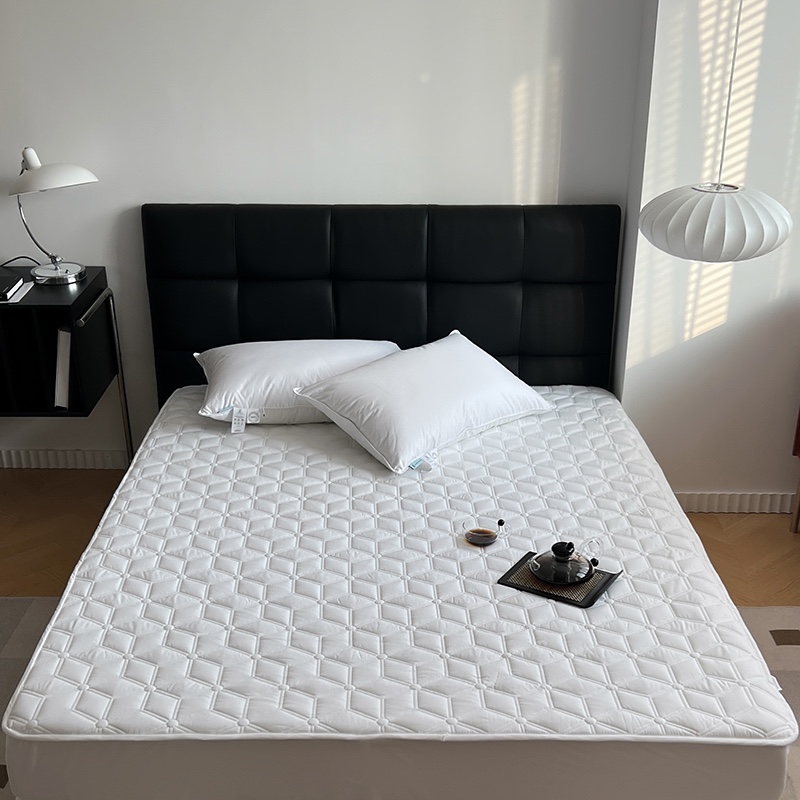
Zone 2 — Bed protection layer: waterproof mattress protector HD3700/HD3701 with 3-stitch, 5-thread sewing and 3 cm corner bands.
Zone 2 — Bed Protection Layer
The protection layer is the most frequently replaced textile in a hotel and the least often specified properly. The Waterproof Mattress Protector (HD3700 and HD3701) uses a cotton shell with environmental setting cotton filling in bright white, sewn to a standard of three stitches and five threads, with 3 cm imported rubber bands evenly added at all four corners so the protector stays seated on the mattress.
Both models tolerate washing or dry cleaning up to 90°C and low-temperature drying. Where a project wants a soft comfort layer instead of a waterproof barrier, the Duck Down Mattress Comforter (HD3000) uses white duck down at 100 g/m² on the upper face and 2–4 cm white duck feather at 1,500 g/m² below, on a 4040 / 133100 down-proof fabric.
For project planning, the deciding measurement is mattress depth and corner geometry, not the fabric. A protector specified without the mattress depth of the actual bed specification is the single most common re-order failure in this zone.
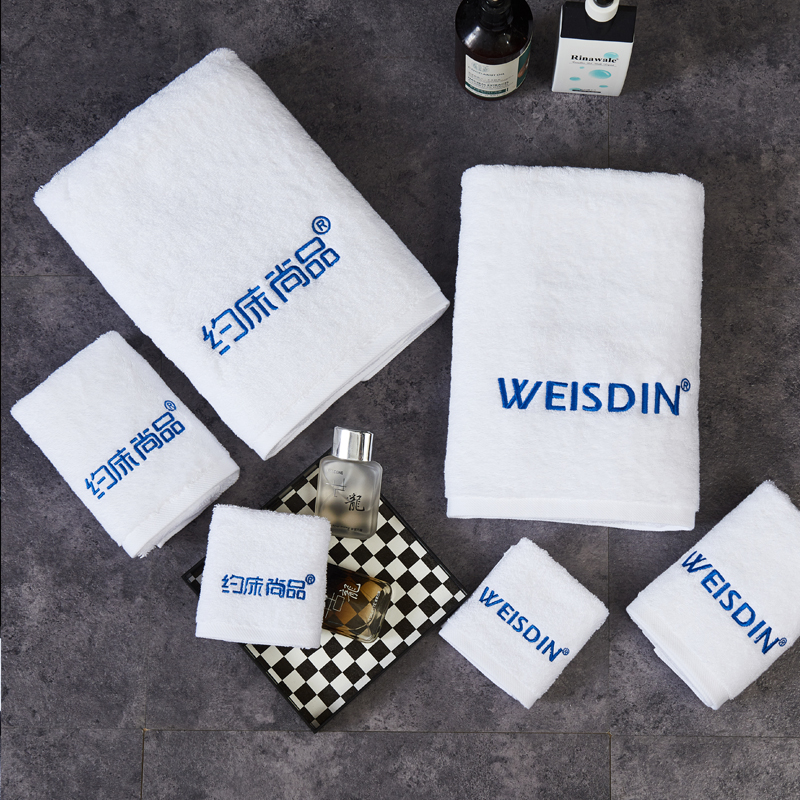
Zone 3 — Bathroom zone: 100% cotton terry towels with honeycomb woven hem and custom logo embroidery.
Zone 3 — Bathroom Zone
Bathroom linen carries the strongest sensory signal in the guestroom and the heaviest laundry load. The towel range covers Plain (MJ8300), Jacquard (MJ8500) and Embroidered (MJ8500) constructions in 100% cotton with 21S/32S yarn, weights from 60 g to 700 g, and sizes from 33×33 cm through 35×75 cm, 40×80 cm, 70×140 cm and 80×150 cm. Bath mats (DJ9100 plain, DJ9200 jacquard, DJ9300 long wool) run from 300 g to 1,300 g in 50×80 cm, 60×90 cm and 60×120 cm, and the Waffle Bathrobe (YP9600) is offered at 700 g, 750 g, 1,000 g and 1,200 g in 120×130×50 cm with kimono or shawl collar constructions.
Three specification points deserve attention at project stage. First, colour retention: terry is washed more often than any other textile in the building under aggressive chemistry, and the range is built with colour-fixation treatment to resist fading. Second, edge durability: reinforced and locked seam edges are specified to resist fraying across continuous wash cycles. Third, logo embroidery, which is available on towels and bathrobes so that the same brand mark appears consistently across the bathroom zone.
Chlorine resistance is a common special requirement for hotel and resort projects with pools or spas. It is a specification the buyer should state explicitly in the RFQ — along with the water chemistry and laundry regime of the property — rather than assume, because chlorine exposure is determined by the operating environment, not by the towel alone.
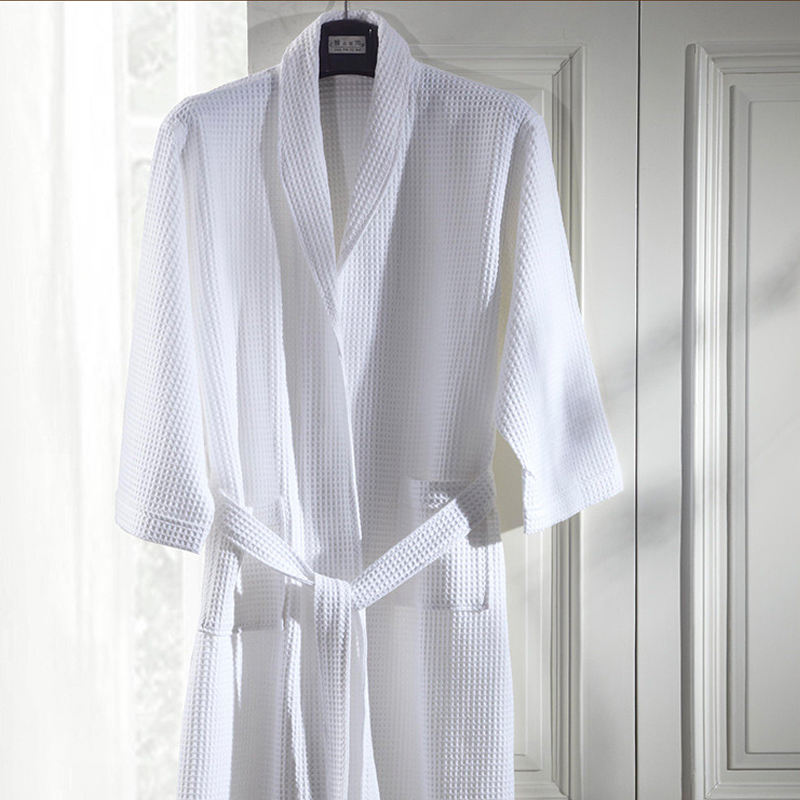
Also in the bathroom zone: the YP9600 waffle bathrobe, breathable and quick-drying, with side pockets and an adjustable waist belt.
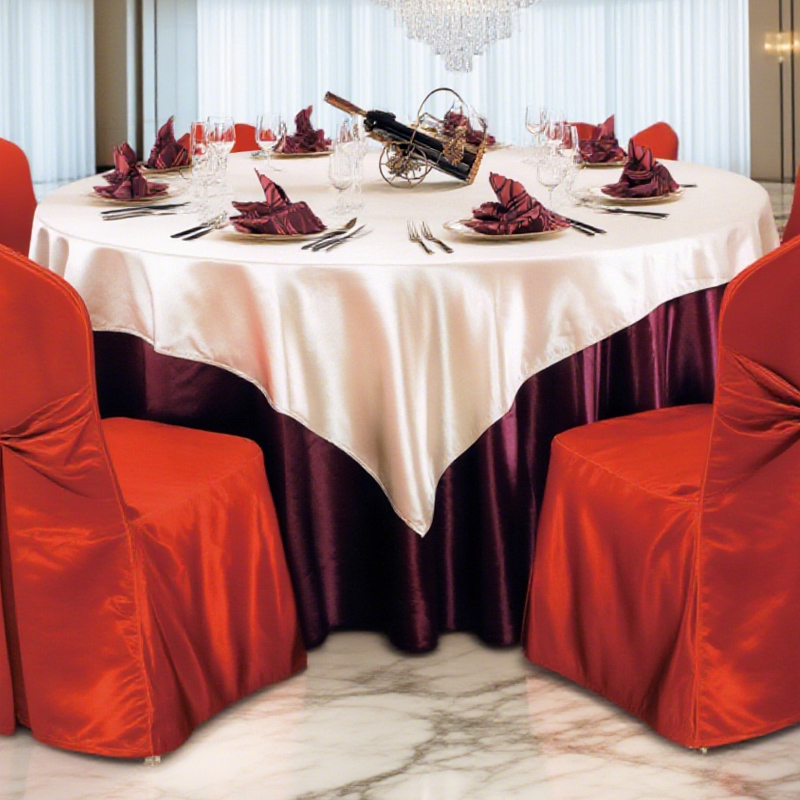
Zone 4 — Food & beverage zone: polyester jacquard table cloth TB1102 with double-needle finished edges.
Zone 4 — Food & Beverage Zone
Restaurant and banquet linen is judged in front of guests, in daylight, by diners who notice a faded cloth more readily than a slightly worn sheet. The Polyester Table Cloth (TB1102) is made from high-precision jacquard fabric in a plain weave with double-needle finished edges, sized at 260×260 cm, 300×300 cm and 320×320 cm. The Cotton Napkin (CJ9800) uses a high-density satin texture at 42s/2×42s/2 with a 103×95 construction in 45×45 cm and 50×50 cm, with stitched ends.
Two properties matter at project stage: colour-locking treatment, so the table presentation stays consistent after repeated commercial laundering, and fabric drape, which determines whether a large table cloth falls cleanly or shows crease lines across the table setting.
Behind the Range: Manufacturing and Customization Capability
Range breadth only matters if it can be produced on schedule and to a repeatable standard. WEISDIN works with a strategic partner factory in Xinjiang and an integrated production base of 340 mu (approximately 227,000 m²) covering cotton cultivation, spinning, weaving and finished-product manufacturing, supported by a modern industrial facility of more than 12,000 m² and five subsidiaries including Youfa, Xuhai, Wolaifei, Hong Kong WEISDIN (International) Trade and Guangdong WEISDIN Technology Co., Ltd.
The commercial parameters a project buyer needs are equally concrete: OEM, ODM and private label production; customization of logo, fabric, size, colour and packaging; monthly capacity of 200,000 bedding sets and 500,000 towels; sample lead time of 7–10 days; production lead time of 20–35 days; minimum order quantity from 50 pcs; 100% pre-shipment inspection; and after-sales support covering sample service and technical support. Company data records an annual output of 2,000,000 pcs, an R&D team of six engineers, and an export ratio of 70%, with main markets in Saudi Arabia, the United States and the European Union.
Step-by-Step Breakdown: Planning a Project Order in Six Steps
- Map the zones and check count parity. Count beds, bathrooms and covers first, then translate them into textile quantities per zone. Zones must be counted from the building plan, not from a supplier's minimum order tier — otherwise MOQ convenience quietly rewrites the property's actual needs.
- Fix one specification baseline per zone. For the sleep layer: yarn count, density, composition and wash temperature. For protection: waterproof versus comfort, mattress depth, corner construction. For the bathroom: towel weight and size matrix, edge construction, logo position. For F&B: table dimensions, drop length, colour-locking requirement.
- Decide where customization actually pays. Logo embroidery on towels and bathrobes, woven or embroidered branding on bedding, and private label packaging are the three customization points that guests and procurement audits both notice. Colour matching to a brand standard — the Wyndham project used Pantone (TCX) matching — belongs at this stage, not after approval.
- Validate with samples before committing volume. Sample lead time is 7–10 days. This step should test hand feel, shrinkage behaviour after a wash cycle, embroidery registration and colour accuracy, because these are the variables that cannot be corrected economically once bulk production has started.
- Lock production and quality control. Production lead time runs 20–35 days, with customized bedding designs listed at 30+ days. Quality control is 100% pre-shipment inspection, which matters more in a one-stop order than in a single-category order because a single shipment now carries bedding, protection, bathroom and F&B items together.
- Plan replacement and after-sales from day one. Record the specification baseline for every zone so that year-three and year-five replacement orders match the original. After-sales support covers sample service and technical support, and the full range is documented in the WEISDIN catalogue.
Use Cases: How Documented Hotel Projects Structured Their Supply
Five-star Radisson project, Kazakhstan
A procurement intermediary client supplied bedding products for a five-star Radisson hotel project covering more than 100 guest rooms. The installation has been documented in use for two years, and the products consistently meet the daily operational needs of 150 guest rooms. The client recognised the quality and durability of the products, and the project developed into a stable, long-term supply relationship. For project planners, the relevant point is that the range was specified for five-star standards first and volume second, and it held up across two years of continuous operation.
Five-star Wyndham project, Kazakhstan
A second intermediary-led project covered a Wyndham five-star hotel procurement of 150 rooms, with an implementation period of three years. Specifications included high-thread-count, high-density weaving, double-needle reinforced edging, precise custom colour matching based on Pantone (TCX), and jacquard weaving carrying the hotel's own brand logo. Documented outcomes were a 100% repeat purchase rate, a 15% increase in hotel guest satisfaction measured by NPS, and zero quality complaints during the cooperation period. The project also addressed quality consistency in hotel textile supply as its central problem — which is exactly the risk that a fragmented supplier list tends to reintroduce.
Hotel group and resort projects, 100–500 rooms
Across hotel group and resort projects in the 100–500 room range, with implementation periods of three to five years and case locations including Saudi Arabia, Malaysia and the United States, the recorded outcomes were reduced procurement cost and stable quality. The delivered solution was a one-stop textile solution supporting customized logos and shrink-proof hotel linens — the same three-part structure described in the zones above: a single specification baseline, one branding standard, and one replacement reference.
Zone and Model Comparison
The table below is a planning map, not a price list. Every specification is drawn from the product data of the corresponding model.
| Project zone | Models in the range | Reference specification | Lock before ordering |
|---|---|---|---|
| Guestroom sleep layer | CP106, CP128, CP139, CP152, CP186 bedding sets; ZX5103 pillow; BX280 duvet; BX296 quilt; CX2120 duvet | Yarn counts 40×40 to 80×80; densities 250T–600T; 100% cotton or 80/20 cotton-polyester; wash to 90°C (CP128 to 70°C); pillow 45×75 / 48×78 cm at 800 g or 1000 g | Thread count and finish per star rating; shrink resistance; embroidery, jacquard or print placement |
| Bed protection layer | HD3700, HD3701 mattress protectors; HD3000 mattress comforter | Cotton shell, environmental setting cotton filling; 3 stitches and 5 threads; 3 cm imported rubber bands at four corners; wash or dry clean to 90°C | Waterproof versus comfort layer per room class; mattress depth and corner fit |
| Bathroom zone | MJ8300 plain towel; MJ8500 jacquard and embroidered towels; DJ9100, DJ9200, DJ9300 bath mats; YP9600 waffle bathrobe | 100% cotton, 21S/32S; towels 60 g–700 g, 33×33 cm to 80×150 cm; bath mats 300 g–1,300 g; bathrobe 700/750/1000/1200 g, 120×130×50 cm | Weight and size matrix per guest segment; logo embroidery position; chlorine-resistance requirement for pool and spa areas |
| Food & beverage zone | TB1102 polyester table cloth; CJ9800 cotton napkin | Table cloth: high-precision jacquard, plain weave, double-needle edges, 260×260 / 300×300 / 320×320 cm; napkin: high-density satin texture, 42s/2×42s/2, 103×95, 45×45 / 50×50 cm | Table drop length per layout; colour-locking performance; drape and folding behaviour |
| Project dimension | Multi-supplier mix | One-stop project supply (WEISDIN reference) |
|---|---|---|
| Zone coverage | Separate vendors per category, each with its own terms and documents | Bedding, bed protection, bathroom and F&B ranges from one manufacturer |
| Specification consistency | Yarn count, weight and finish defined independently by each vendor | One specification baseline across categories, with colour and logo standards applied consistently |
| Sample validation | Multiple sample rounds at different speeds | Sample lead time 7–10 days; production 20–35 days |
| Order flexibility | MOQ set separately by each vendor | MOQ from 50 pcs; towel and bath mat models listed at 100 pcs; customized bedding designs at 100 sets |
| Quality control | Inspection responsibility split across suppliers | 100% pre-shipment inspection |
| Customization | Logo, colour and packaging handled per vendor | OEM, ODM and private label with logo, fabric, size, colour and packaging customization |
| Coordination | Multiple freight, documentation and contact points | Consolidated ordering with a single contact point, plus sample service and technical support after delivery |
FAQ
How do buyers verify compliance when ordering one-stop comprehensive hotel supplies from a Chinese manufacturer?
Start from the applicable standard, then match it to the exact article. OEKO-TEX® STANDARD 100 is the primary global safety benchmark for hotel textiles and addresses more than 1,000 harmful substances, according to OEKO-TEX® Service GmbH. For a project order, the certificate presented must name the same fabric, colour and finish as the item being ordered, not a generic company document. Documentation should also cover the declared wash regime — for example bedding in this range is specified for machine washing or dry cleaning up to 90°C, except the Sateen set at 70°C. Quality control on WEISDIN orders is carried out as 100% pre-shipment inspection, and the applicable certification scope for a specific article should be confirmed with the supplier at quotation stage.
What should a Chinese one-stop hotel supplies manufacturer provide for a hotel project?
It should be able to cover the zones that share a laundry cycle and a branding standard. The WEISDIN range covers bedroom sets, hotel bedding sets, sheets, pillows, pillow cases, duvets, mattress toppers and mattress protectors, chair covers, towels, bath mats, bathrobes, table cloths and napkins. Production is offered under OEM, ODM and private label arrangements, with customization of logo, fabric, size, colour and packaging. Capability includes monthly capacity of 200,000 bedding sets and 500,000 towels, which allows a project order and its replacement order to be produced against the same specification.
Does one-stop sourcing reduce the total cost of a hotel project?
It changes where the cost sits rather than simply lowering it. Four zones ordered from four vendors multiply freight consolidation work, inspection steps, documentation and administrative contact points. Consolidating them into one order removes that duplicated overhead, and uniform specifications reduce the volume of rejected or re-ordered items later. In documented hotel group and resort projects covering 100–500 rooms with three-to-five-year implementation periods, the recorded outcome was reduced procurement cost and stable quality. Unit prices depend on specification and volume, so they should be confirmed by quotation rather than assumed from the sourcing model.
What is the sample process and what are the minimum order quantities?
Sample lead time is 7–10 days. Minimum order quantity starts from 50 pcs on a capability basis, while individual models carry their own listed minimums: towel and bath mat models are listed at MOQ 100 pcs, and customized bedding designs are listed at MOQ 100 sets. Sample orders are accepted for the towel, bath mat and mattress protector models. A sample should be checked for hand feel, shrinkage after one wash cycle, embroidery registration and colour accuracy, because those four points determine whether bulk production will match the approved reference.
What is the production lead time, and how does a project enquiry start?
Production lead time is 20–35 days, with customized bedding designs listed at 30+ days, following a 7–10 day sampling stage. Monthly capacity is 200,000 bedding sets and 500,000 towels, and export experience covers Saudi Arabia, the United States and the European Union across a 70% export ratio. To start, send the zone list and the required specifications — sizes, weights, thread counts, logo placement and expected quantity per zone — and the team will return a specification-matched quotation and sample plan. Requests can be sent to vicky889@weisdin.cn or by WhatsApp on +86 18925118522, and the full product range is available in the WEISDIN 2026 catalogue.
Conclusion: One Specification Baseline, One Branding Standard, One Replacement Reference
A hotel project rarely fails because one towel was the wrong weight. It fails because the guestroom, bathroom, bed protection and restaurant zones were planned by different people, with different specification language and different replacement timelines, until nobody could say what the property had actually standardised on.
Zone-based planning fixes that. Define four zones — sleep layer, bed protection, bathroom, food and beverage — set one specification baseline for each, validate with samples before committing volume, and keep the recorded baseline as the reference for every future replacement order. A one-stop manufacturer is useful precisely because it can hold those four baselines inside one production and quality-control system, from a 50 pcs minimum order up to project volumes across bedding and towels.

Planning a hotel project or refurbishment? Send your zone list and specifications to WEISDIN and receive a specification-matched quotation, sample plan and lead-time schedule.
Email: vicky889@weisdin.cn | WhatsApp: +86 18925118522 | Website: www.weisdin.com
Download the full range: WEISDIN 2026 Product Catalogue (PDF)
Guangdong Weisdin Industrial Co., Ltd. — Professionalism · Wisdom · Passion. Where there is a hotel, there is WEISDIN.
Have Questions or Need More Details?
Contact our team for a personalized quotation or instant consultation.
Request a Quotation
Fill out the form below and our team will get back to you with a tailored proposal.
WhatsApp Direct Chat
Prefer to chat in real-time? Message us on WhatsApp for instant assistance & quick answers.
- Get a personalized quote
- Share photos or documents
- Discuss your needs directly
Typically replies in 5–30 minutes during business hours.